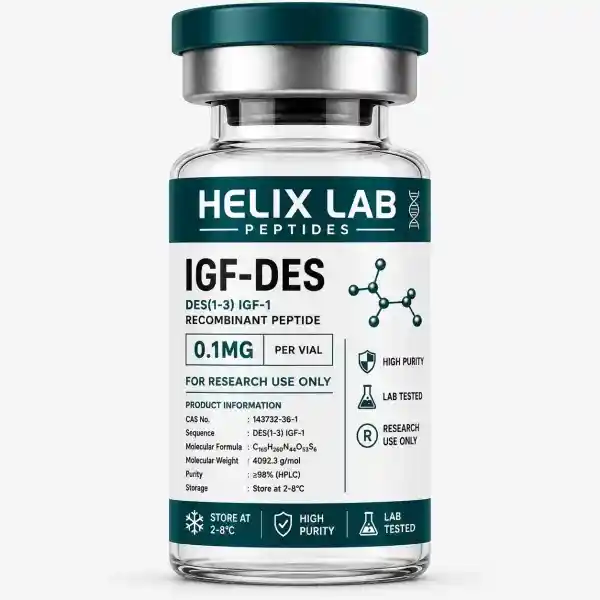
IGF-DES 0.1mg
Product Name: IGF-DES Strength: 0.1mg (100mcg) Full Name: Des(1-3) Insulin-Like Growth Factor-1 Alternative Names: IGF-1 DES, DES(1-3) IGF-1, Des-IGF-1 Research Category: IGF-1 Analog / Growth Factor Research Peptide Peptide Type: Truncated IGF-1 Analog Research Target: Insulin-Like Growth Factor 1 Receptor (IGF-1R) Research Interest: IGF-1 receptor signaling, cellular growth, proliferation, differentiation, protein-synthesis pathways, tissue biology, and growth-factor research. Description
IGF-DES, also known as Des(1-3) IGF-1, is a truncated analog of insulin-like growth factor-1 (IGF-1). It lacks the first three amino acids present at the N-terminus of native IGF-1 and is used experimentally to investigate IGF-related receptor signaling and cellular growth pathways. Structural Modification
IGF-DES is derived from IGF-1 through removal of the first three N-terminal amino acids. This structural modification alters its interactions with certain IGF-binding proteins and provides researchers with a useful analog for studying IGF-1 signaling under controlled experimental conditions. Mechanism of Research
IGF-DES interacts primarily with the insulin-like growth factor-1 receptor (IGF-1R). Activation of this receptor can initiate intracellular signaling pathways associated with cell proliferation, differentiation, survival, protein synthesis, and metabolic regulation. Research Applications
Research involving IGF-DES includes IGF-1 receptor biology, growth-factor signaling, cellular proliferation and differentiation, protein-synthesis pathways, tissue and muscle cell biology, and interactions between IGF analogs and IGF-binding proteins. Storage
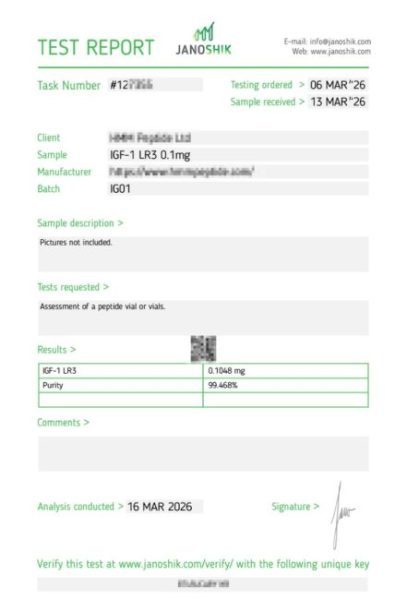
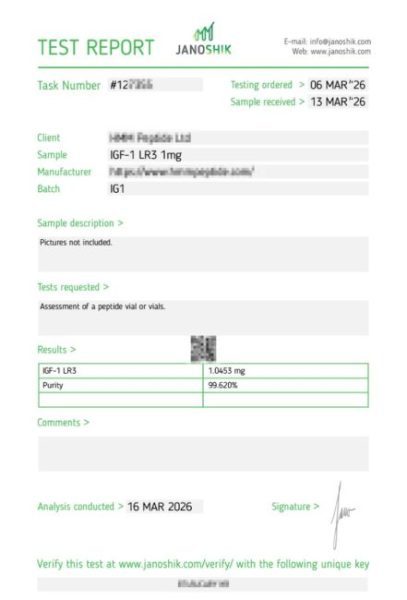
Storage requirements depend on the formulation and supplier. Research material should be stored according to the accompanying certificate of analysis (COA), product specification sheet, and manufacturer instructions. Research Use Disclaimer
IGF-DES is an investigational research compound and is not an approved therapeutic product. Information provided here is for scientific and research reference purposes only and should not be interpreted as medical, prescribing, or dosing advice.